Makushin CFE II
Start: 8050 yBP ± 80 Years [1]
Event Type: Explosive
Max VEI: 5 [2]
- Tephrafall [1]
Description: From Beget and others (2000): "The oldest deposits of Makushin Volcano that post-date the last ice age record a series of very large eruptions, culminating in the development of a summit caldera (fig. 4 [in original text]). These eruptions began about 8,400 to 8,800 years ago, when a large debris avalanche occurred on the north flank of the volcano and traveled at least 10 kilometers to the coast. On the basis of bathymetry, this avalanche deposit may extend an additional 3 to 5 kilometers off-shore. The upper part of the avalanche deposit is gradational into very coarse grained surge deposits that record a lateral blast apparently coincident with the debris avalanche."
From Bean (1999): "Two early Holocene "caldera forming" eruptive events, dated at 8050 yr B.P. and ca. 8790 yr B.P. respectively, generated the vast bulk of pyroclastic debris which fill valleys proximal to the volcano. Total erupted volume for early Holocene unconsolidated deposits approaches 10 km 3. The eruptions produced very mobile pyroclastic flows that traveled as far as Dutch Harbor (25 km away) where they buried an ancient Native American culture in more than 30 cm of hot ash and rock fragments."
"A distinct, several cm thick, poorly-sorted orange, coarse sandy flow unit lies above the soils. This flow unit is stratigraphically low in section and thought to represent the earliest large Holocene eruptions. It is informally named the earliest caldera forming event (CFE1) unit. The CFE1 is separated from overlying flow deposits by a thin (~2 cm) organic rich soil which locally contains charcoal fragments. Age dates for this deposit average around 8050 14C yr B.P. (Table 6.1 [in original text]). The CFE1 is not present at all localities suggesting a more restricted flow and smaller eruptive event, or poorer preservation than later large events."
"Overlying the lower CFE1 unit is the distinct CFE2 unit. It is orange-red, poorly sorted and massive coarse sand with common pumice, scoria lapilli, and lithics. CFE2 is generally thicker (usually 20-30 cm) than CFE1 but is even thicker in some locations. The base of this unit locally is commonly red and very indurated. At a site near the airport (96MAK23), faint cross-bedding is present and scoria lapilli up to 2.5 cm diameter were found in the deposit (Fig. 4.25 [in original text]). The CFE2 is commonly underlain by several cm of dark gray well-sorted sandy tephras and is less commonly overlain by a thin (~1 cm) of fine orange ash. Several cm of gray ashy silt commonly separate the CFE2 from a thin 2 cm yellow pumice unit containing small glassy lithics. The pumice unit can be found in most distal sites and has been geochemically correlated with proximal deposits of the Driftwood Pumice."
"At site 97MAK14, CFE2 deposits were found overlying till from the only known moraine in the Dutch Harbor area. The moraine is exposed behind a local machine shop in Dutch Harbor, and apparently once stretched across what is today Unalaska Lake. The moraine is most likely latest Pleistocene to earliest Holocene in age."
From Beget and others (2000): "Numerous pyroclastic-flow deposits fill valleys on the east, northeast, north, and west of the volcano, and have been dated to about 8,000 to 8,100 years before present (Bean, 1999). The pyroclastic flow deposits are more than 100 meters thick at the head of Makushin Valley and can be traced downvalley 20 kilometers to the shore of Unalaska Bay, where they reach a maximum thickness of 3 meters. Correlative pyroclastic deposits containing incinerated plants occur at Hog Island, 7 kilometers farther to the east across Unalaska Bay, where they are 1 to 2 meters thick. The summit caldera was produced during the pyroclastic flow eruptions 8,000 to 8,100 years ago."
From Bean (1999): "Two early Holocene "caldera forming" eruptive events, dated at 8050 yr B.P. and ca. 8790 yr B.P. respectively, generated the vast bulk of pyroclastic debris which fill valleys proximal to the volcano. Total erupted volume for early Holocene unconsolidated deposits approaches 10 km 3. The eruptions produced very mobile pyroclastic flows that traveled as far as Dutch Harbor (25 km away) where they buried an ancient Native American culture in more than 30 cm of hot ash and rock fragments."
"A distinct, several cm thick, poorly-sorted orange, coarse sandy flow unit lies above the soils. This flow unit is stratigraphically low in section and thought to represent the earliest large Holocene eruptions. It is informally named the earliest caldera forming event (CFE1) unit. The CFE1 is separated from overlying flow deposits by a thin (~2 cm) organic rich soil which locally contains charcoal fragments. Age dates for this deposit average around 8050 14C yr B.P. (Table 6.1 [in original text]). The CFE1 is not present at all localities suggesting a more restricted flow and smaller eruptive event, or poorer preservation than later large events."
"Overlying the lower CFE1 unit is the distinct CFE2 unit. It is orange-red, poorly sorted and massive coarse sand with common pumice, scoria lapilli, and lithics. CFE2 is generally thicker (usually 20-30 cm) than CFE1 but is even thicker in some locations. The base of this unit locally is commonly red and very indurated. At a site near the airport (96MAK23), faint cross-bedding is present and scoria lapilli up to 2.5 cm diameter were found in the deposit (Fig. 4.25 [in original text]). The CFE2 is commonly underlain by several cm of dark gray well-sorted sandy tephras and is less commonly overlain by a thin (~1 cm) of fine orange ash. Several cm of gray ashy silt commonly separate the CFE2 from a thin 2 cm yellow pumice unit containing small glassy lithics. The pumice unit can be found in most distal sites and has been geochemically correlated with proximal deposits of the Driftwood Pumice."
"At site 97MAK14, CFE2 deposits were found overlying till from the only known moraine in the Dutch Harbor area. The moraine is exposed behind a local machine shop in Dutch Harbor, and apparently once stretched across what is today Unalaska Lake. The moraine is most likely latest Pleistocene to earliest Holocene in age."
From Beget and others (2000): "Numerous pyroclastic-flow deposits fill valleys on the east, northeast, north, and west of the volcano, and have been dated to about 8,000 to 8,100 years before present (Bean, 1999). The pyroclastic flow deposits are more than 100 meters thick at the head of Makushin Valley and can be traced downvalley 20 kilometers to the shore of Unalaska Bay, where they reach a maximum thickness of 3 meters. Correlative pyroclastic deposits containing incinerated plants occur at Hog Island, 7 kilometers farther to the east across Unalaska Bay, where they are 1 to 2 meters thick. The summit caldera was produced during the pyroclastic flow eruptions 8,000 to 8,100 years ago."
Impact: From Bean (1999): "Human artifacts are preserved in the thin soil (dated at ~8050 14C yr B.P.) underlying the CFE2 volcanic deposits on Hog Island. This horizon represents one of the oldest known human cultures in the Aleutian Islands according to archeologists Dr. Don Dumond professor emeritus at the University of Oregon and Dr. Rick Knecht, director of the Museum of the Aleutians in Dutch Harbor. Human occupation of the Dutch Harbor area ends with this horizon and does not reappear until approximately 4000 years later (Knecht, personal communication 1997). This suggests that the later caldera forming eruption (CFE2) strongly affected and perhaps destroyed local Aleut settlements, and forced any remaining local inhabitants to relocate. Consistent with our three dates from the same horizon, Knecht (1997 personal communication) and Dumond (1999 personal communication) report age dates of 7950+/-90 14C yr B.P. and 8050+/-80 14C yr B.P. on soil from the cultural horizon." [1]
References Cited
[1] The Holocene eruptive history of Makushin Volcano, Alaska, 1999
Bean, K. W., 1999, The Holocene eruptive history of Makushin Volcano, Alaska: University of Alaska Fairbanks unpublished M.S. thesis, Fairbanks, AK, 130 p. full-text PDF 6.1 MB
 [2] Volcanoes of the World, 2013
Global Volcanism Program, 2013, Volcanoes of the World, v. 4.5.3. Venzke, E (ed.): Smithsonian Institution. Downloaded 2017. http://dx.doi.org/10.5479/si.GVP.VOTW4-2013[3] Late Quaternary caldera-forming eruptions in the eastern Aleutian arc, Alaska, 1987
Miller, T. P., and Smith, R. L., 1987, Late Quaternary caldera-forming eruptions in the eastern Aleutian arc, Alaska: Geology, v. 15, n. 5, p. 434-438.
full-text PDF 2.5 MB [4] Catalog of the historically active volcanoes of Alaska, 1998
Miller, T. P., McGimsey, R. G., Richter, D. H., Riehle, J. R., Nye, C. J., Yount, M. E., and Dumoulin, J. A., 1998, Catalog of the historically active volcanoes of Alaska: U.S. Geological Survey Open-File Report 98-0582, 104 p.
intro and TOC PDF 268 KB
references PDF 43 KB [5] Volcanoes of North America: United States and Canada, 1990
Wood, C. A., and Kienle, Juergen, (eds.), 1990, Volcanoes of North America: United States and Canada: New York, Cambridge University Press, 354 p.[6] Preliminary volcano-hazard assessment for Makushin Volcano, Alaska, 2000
Beget, J. E., Nye, C. J., and Bean, K. W., 2000, Preliminary volcano-hazard assessment for Makushin Volcano, Alaska: Alaska Division of Geological & Geophysical Surveys Report of Investigation 2000-4, 22 p., 1 sheet, scale 1:100,000.
full-text PDF .87 MB
map sheet plate 7.68 MB [7] Geomorphic consequences of volcanic eruptions in Alaska: A review, 2015
Waythomas, C.F., 2015, Geomorphic consequences of volcanic eruptions in Alaska: A review: Geomorphology, v. 246, p. 123-145, doi: 10.1016/j.geomorph.2015.06.004Complete Eruption References
Makushin Volcano ash hazards, 2025
Dietterich, H.R., Schaefer, J.R., Larsen, J.F., Vallance, J.W., Van Eaton, A.R., and Wallace, K.L., 2025, Makushin Volcano ash hazards: Alaska Division of Geological & Geophysical Surveys Information Circular 86 v. 2, 2 p. https://doi.org/10.14509/31684
Full-text PDF 2 MB Geomorphic consequences of volcanic eruptions in Alaska: A review, 2015
Waythomas, C.F., 2015, Geomorphic consequences of volcanic eruptions in Alaska: A review: Geomorphology, v. 246, p. 123-145, doi: 10.1016/j.geomorph.2015.06.004
Volcanoes of the World, 2013
Global Volcanism Program, 2013, Volcanoes of the World, v. 4.5.3. Venzke, E (ed.): Smithsonian Institution. Downloaded 2017. http://dx.doi.org/10.5479/si.GVP.VOTW4-2013
Preliminary volcano-hazard assessment for Makushin Volcano, Alaska, 2000
Beget, J. E., Nye, C. J., and Bean, K. W., 2000, Preliminary volcano-hazard assessment for Makushin Volcano, Alaska: Alaska Division of Geological & Geophysical Surveys Report of Investigation 2000-4, 22 p., 1 sheet, scale 1:100,000.
full-text PDF .87 MB
map sheet plate 7.68 MB 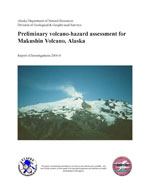
The Holocene eruptive history of Makushin Volcano, Alaska, 1999
Bean, K. W., 1999, The Holocene eruptive history of Makushin Volcano, Alaska: University of Alaska Fairbanks unpublished M.S. thesis, Fairbanks, AK, 130 p.
full-text PDF 6.1 MB 
Catalog of the historically active volcanoes of Alaska, 1998
Miller, T. P., McGimsey, R. G., Richter, D. H., Riehle, J. R., Nye, C. J., Yount, M. E., and Dumoulin, J. A., 1998, Catalog of the historically active volcanoes of Alaska: U.S. Geological Survey Open-File Report 98-0582, 104 p.
intro and TOC PDF 268 KB
references PDF 43 KB 
Volcanoes of North America: United States and Canada, 1990
Wood, C. A., and Kienle, Juergen, (eds.), 1990, Volcanoes of North America: United States and Canada: New York, Cambridge University Press, 354 p.
Hard Copy held by AVO at FBKS - CEC shelf
Late Quaternary caldera-forming eruptions in the eastern Aleutian arc, Alaska, 1987
Miller, T. P., and Smith, R. L., 1987, Late Quaternary caldera-forming eruptions in the eastern Aleutian arc, Alaska: Geology, v. 15, n. 5, p. 434-438.
full-text PDF 2.5 MB