Snowy


Facts


  • Official Name: Snowy Mountain
  • Seismically Monitored: Yes
  • Color Code: GREEN
  • Alert Level: NORMAL
  • Elevation: 2161m (7089ft)
  • Latitude: 58.3336
  • Longitude: -154.6859
  • Smithsonian VNum: 312200
  • Pronunciation:
  • Nearby Towns:
    • Karluk 53 mi (86 km) SE
    • Larsen Bay 61 mi (98 km) SE
    • Aleneva 68 mi (110 km) SE
    • Kanatak 72 mi (117 km) SW
    • Port Lions 73 mi (118 km) SE

    Distance from Anchorage: 260 mi (418 km)

Description

From Hildreth and Fierstein, 2003 [1] : “Snowy Mountain is a small andesite-dacite volcanic center that straddles the rangecrest northeast of the main Katmai cluster, separated by about 10 km from Mount Griggs. Snowy Mountain was named during the National Geographic Society expedition to Katmai in 1917 (Griggs, 1922 [2] , p. 131). The name chosen evidently reflected how impressed those explorers were with its extensive mantle of snow and ice as seen from upper Katmai River, which was their closest approach to the edifice. Rising to an elevation of 7,090 ft (2,161 m), Snowy Mountain remains today the source of 10 substantial glaciers. Because glacial ice still covers nearly 90 percent of the edifice, the principal rock exposures are limited to narrow ice-bounded arêtes at higher elevations and ice-scoured lava-flow benches at lower elevations.
“Activity began at about 200 ka, and infrequent eruptions have since taken place from two vents 4 km apart that built contiguous subedifices which extensively overlap in age [3] . Only the northeast vent has been active in the Holocene. Sector collapse of the hydrothermally weakened upper part of the northeast cone in the late Holocene produced a 22-square-km debris avalanche and left a 1.5-square-km amphitheater that was subsequently occupied by a blocky dacite lava dome. Many products of the southwest vent are olivine-bearing andesites (55-62 percent SiO2), whereas those of the northeast vent are largely pyroxene dacites (62-64 percent SiO2). Estimates of eruptive volume yield 8+/-2 cubic km for the northeastern edifice, 5 +/- 2 cubic km for the southwestern, and 13 +/- 4 cubic km for the Snowy Mountain center as a whole. Only half to two-thirds of this material remains in place on the glacially ravaged skeletal edifices today."
From Wood and Kienle, 1990 [4] : "An active fumarole field on the summit of the tallest peak has melted holes through the ice. A zone of active shallow-level seismicity beneath Snowy Mountain is probably a manifestation of a hydrothermal system. This, together with its youthful, undissected form, suggests that volcanism at Snowy Mountain is recent. But no historic activity has been reported."

Name Origin

"Snowy Mountain" was identified by R.F. Griggs in 1916 as "Princess Peak" and then, in 1919, as "Snowy Mountain", "because of the extensive glaciers nearby" (Orth, 1971).


References Cited

[1] Geologic map of the Katmai volcanic cluster, Katmai National Park, Alaska, 2003

Hildreth, Wes, and Fierstein, Judy, 2003, Geologic map of the Katmai volcanic cluster, Katmai National Park, Alaska: U.S. Geological Survey Miscellaneous Investigation Series Map I 2778, unpaged, 1 sheet, scale 1:63,360.
full-text PDF 23.9 MB

[2] The Valley of Ten Thousand Smokes, 1922

Griggs, R. F., 1922, The Valley of Ten Thousand Smokes: Washington, DC, National Geographic Society, 340 p., 3 sheets, scale unknown.

[3] Snowy Mountain: A pair of small andesite-dacite stratovolcanoes in Katmai National Park, 2001

Hildreth, E. W., Fierstein, Judy, Lanphere, M. A., and Siems, D. F., 2001, Snowy Mountain: A pair of small andesite-dacite stratovolcanoes in Katmai National Park: in Gough, L. P. and Wilson, F. H., (eds.), Geologic studies in Alaska by the U.S. Geological Survey, 1999, U.S. Geological Survey Professional Paper PP 1633, p. 13-34.
full-text PDF 3.7 MB

[4] Volcanoes of North America: United States and Canada, 1990

Wood, C. A., and Kienle, Juergen, (eds.), 1990, Volcanoes of North America: United States and Canada: New York, Cambridge University Press, 354 p.

Current Activity

No new updates for Snowy volcano since March 18, 2022, 3:33 pm.

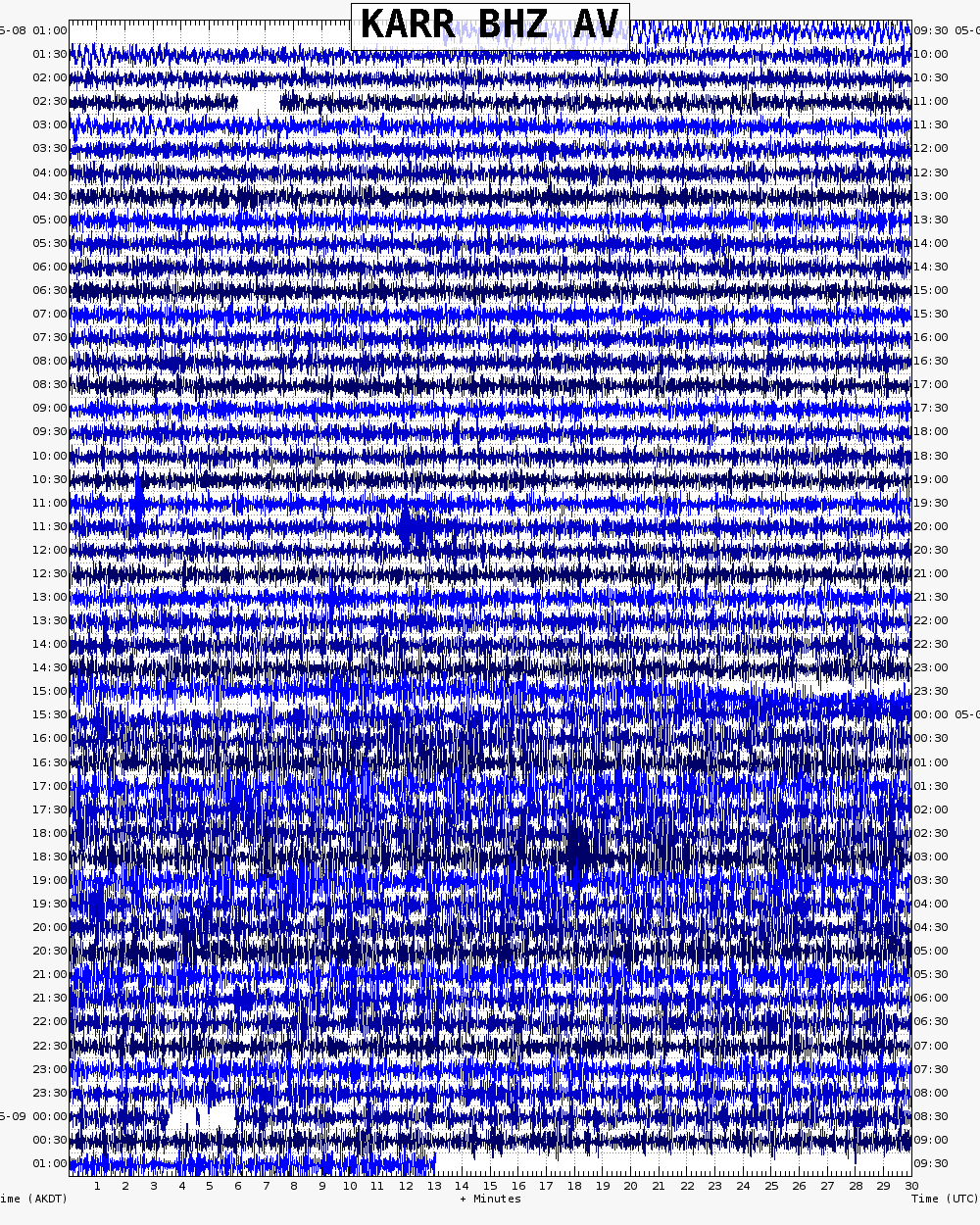
Webicorder

Color Code Timeline

Loading Past Activity...

Loading Images...

Loading Maps...

Loading Bibliography...

Ash Forecasting

Mathematical models developed by the USGS forecast various aspects of how a volcanic ash plume will interact with wind—where, how high, and how fast ash particles will be transported in the atmosphere, as well as where ash will fall out and accumulate on the ground. AVO runs these models when a volcano is restless by assuming a reasonable hypothetical eruption, to provide a pre-eruptive forecast of areas likely to be affected. During an ongoing eruption, AVO will update the forecast with actual observations (eruption start time and duration, plume height) as they become available.

View the current airborne ash cloud models for Snowy

Ashfall thickness forecast

The Ash3d model was developed by the USGS to forecast how a volcanic ash plume will interact with wind and where ash will fall out and accumulate on the ground. AVO runs these models twice daily when a volcano is restless by assuming a reasonable hypothetical eruption altitude and duration. The map shows the model results of ashfall thickness for areas that are likely to be affected, if one were to occur. During an ongoing eruption, AVO will update the forecast with actual observations (eruption start time and duration, plume height) as they become available, and these plots will be automatically updated. The National Weather Service Anchorage Forecast Office will issue the official ashfall warning product and post them at weather.gov/afc

THESE PRODUCTS MAY NOT BE CURRENT.

During an actual eruption, see National Weather Service forecasts of ashfall:https://weather.gov/afc.

Ashfall Forecast

Click on the X on the graphic (upper right) to expand the map to show the map legend.

Ashfall Start Time

This map shows the modeled estimate of the time it would take for ashfall to begin following an eruption. It corresponds to the ashfall thickness forecast map shown above. This map uses the start time of either the twice-daily hypothetical model runs (time shown in the legend) or the actual eruption start time (if one were to occur). In the case of an actual eruption, the National Weather Service Anchorage Forecast Office will issue the official ashfall warning product that includes the ashfall start time and post them at weather.gov/afc

THESE PRODUCTS MAY NOT BE CURRENT.

During an actual eruption, see National Weather Service forecasts of ashfall:https://weather.gov/afc.

Ashfall Start Times Forecast

Click on the X on the graphic (upper right) to expand the map to show the map legend.
× Instrument data