Aleutians
(52.0765, -176.1109) WATCH
WATCH 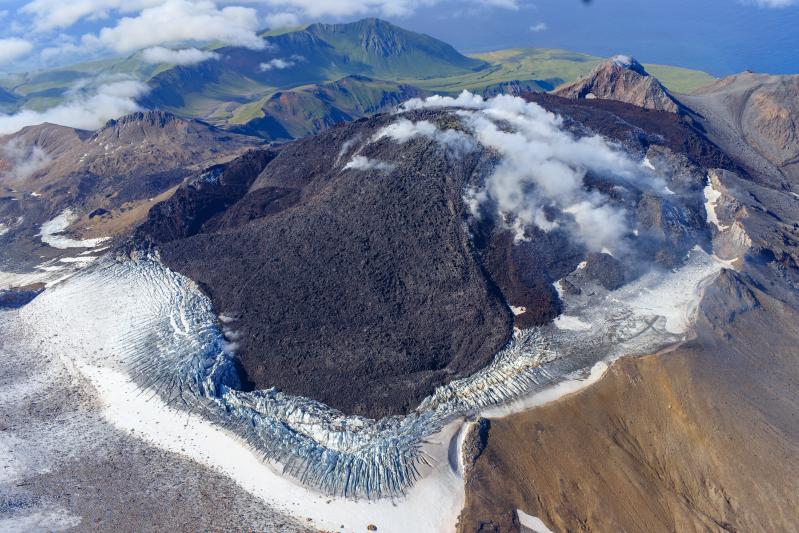
Lava continues to erupt slowly within the summit crater at Great Sitkin Volcano. Weakly elevated surface temperatures were observed a few times this week during breaks in the cloud cover. Otherwise, most views of the lava dome were obscured by clouds. Seismicity has been low, with occasional small earthquakes and rockfalls detected in seismic data. Overall, the rate of lava effusion is declining gradually.
The current lava eruption began in July 2021 and has filled most of the summit crater and advanced into valleys below. There have been no explosions at Great Sitkin Volcano since an event in May 2021. The volcano is monitored using local seismic and infrasound sensors, satellite data and web cameras, and regional infrasound and lightning networks.
 Instrumented
Aleutians
(54.7554, -163.9711) ADVISORY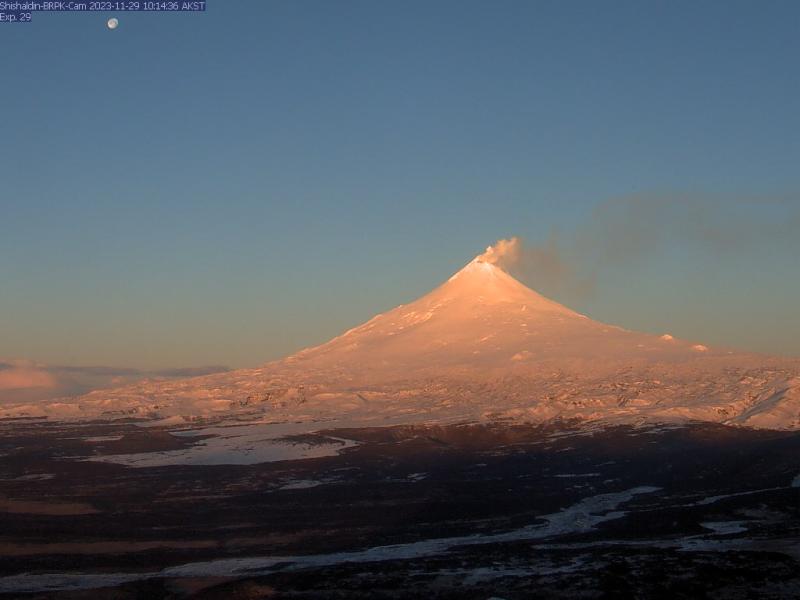
This week, signs of volcanic unrest at Shishaldin continued to be observed. Daily web-camera images showed steaming from the summit crater. Additionally, satellite images captured a diffuse vapor plume on several occasions. There has been ongoing low-level seismic activity, with frequent small earthquakes occurring each day. Infrasound signals, likely caused by gas bubbles bursting through magma deep within the volcanic vent, were also detected throughout the week. However, satellite data revealed no signs of elevated temperatures or other changes within the summit crater, indicating that there is no lava present at or near the surface.
Shishaldin Volcano is monitored by local seismic and infrasound sensors, web cameras, and a telemetered geodetic network. In addition to the local monitoring network, AVO uses nearby geophysical networks, regional infrasound and lighting data, and satellite images to monitor the volcano.
Instrumented