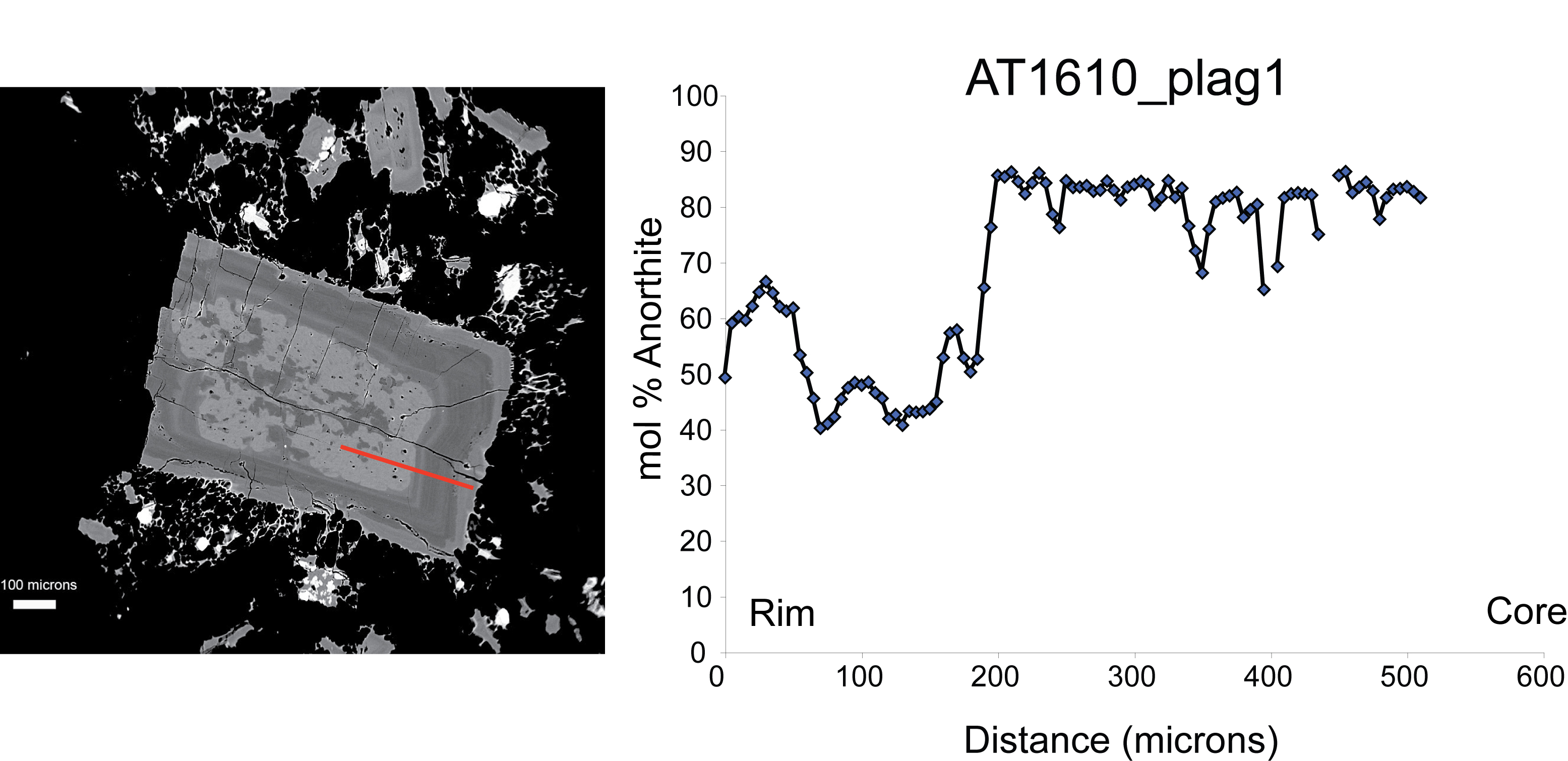
Plagioclase transect from rim to core across part of a phenocryst in AT-1610. The electron microprobe traversed along the red line in the image to the left. The composition along that line is shown in the graph to the right. The mol % anorthite essentially tracks the amount of calcium oxide in the crystal. Higher calcium concentrations reflect more water in a magma that probably also has lower silicon (like basalt or basaltic andesite). The lower calcium plagioclase usually crystallizes in magma that has more silicon (dacite and rhyolite), and also possibly less water. This crystal is compositionally zoned, with lower calcium concentrations towards the rim, and a highly calcic core. The core (~An80-85) has a coarsely sieved texture, meaning that it contains glass pockets inside. Data collected in the Advanced Instrumentation Laboratory, UAF.
Volcano(es): Redoubt
Photographer: Larsen, Jessica
URL: avo.alaska.edu/image/view/17571
Credit: Image courtesy of the AVO/UAF-GI.
Use Restriction: Please cite the photographer and the Alaska Volcano Observatory / University of Alaska Fairbanks, Geophysical Institute when using this image.
Full Resolution.
Redoubt 2009/3
From Schaefer (ed), 2012: "Redoubt Volcano, an ice-covered stratovolcano on the west side of Cook Inlet, erupted in March 2009 after several months of escalating unrest. The 2009 eruption of Redoubt Volcano shares many similarities with eruptions documented most recently at Redoubt in 1966-68 and 1989-90. In each case, the eruptive phase lasted several months, consisted of multiple ash-producing explosions, produced andesitic lava and tephra, removed significant amounts of ice from the summit crater and Drift glacier, generated lahars that inundated the Drift River valley, and culminated with the extrusion of a lava dome in the summit crater. Prior to the 2009 explosive phase of the eruption, precursory seismicity lasted approximately six months with the first weak tremor recorded on September 23, 2008. The first phreatic explosion was recorded on March 15, and the first magmatic explosion occurred seven days later, at 22:34 on March 22. The onset of magmatic explosions was preceded by a strong, shallow swarm of repetitive earthquakes that began about 04:00 on March 20, 2009, less than three days before an explosion. Nineteen major ash-producing explosions generated ash clouds that reached heights between 17,000 ft and 62,000 ft (5.2 and 18.9 km) ASL. During ash fall in Anchorage, the Ted Stevens International Airport was shut down for 20 hours, from ~17:00 on March 28 until 13:00 on March 29. On March 23 and April 4, lahars with flow depths to 10 m in the upper Drift River valley inundated parts of the Drift River Terminal (DRT). The explosive phase ended on April 4 with a dome collapse at 05:58. The April 4 ash cloud reached 50,000 ft (15.2 km) and moved swiftly to the southeast, depositing up to 2 mm of ash fall in Homer, Anchor Point, and Seldovia. At least two and possibly three lava domes grew and were destroyed by explosions prior to the final lava dome extrusion that began after the April 4 event. The final lava dome ceased growth by July 1, 2009, with an estimated volume of 72 Mm3."
Wallace and others (2012) calcuate a total Dense Rock Equivalent of about 0.02 cubic meters for tephra fall from the Redoubt 2009 eruption.