Aleutians
(52.0765, -176.1109) WATCH
WATCH 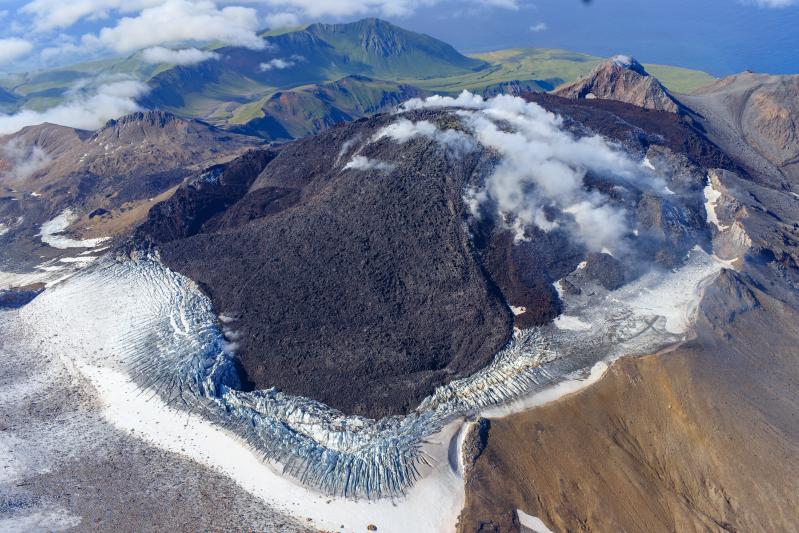
Lava continues to erupt slowly within the summit crater at Great Sitkin Volcano. Weakly elevated surface temperatures were observed a few times this week during breaks in the cloud cover. Otherwise, most views of the lava dome were obscured by clouds. Seismicity has been low, with occasional small earthquakes and rockfalls detected in seismic data. Overall, the rate of lava effusion is declining gradually.
The current lava eruption began in July 2021 and has filled most of the summit crater and advanced into valleys below. There have been no explosions at Great Sitkin Volcano since an event in May 2021. The volcano is monitored using local seismic and infrasound sensors, satellite data and web cameras, and regional infrasound and lightning networks.
 Instrumented
Aleutians
(54.7554, -163.9711) ADVISORY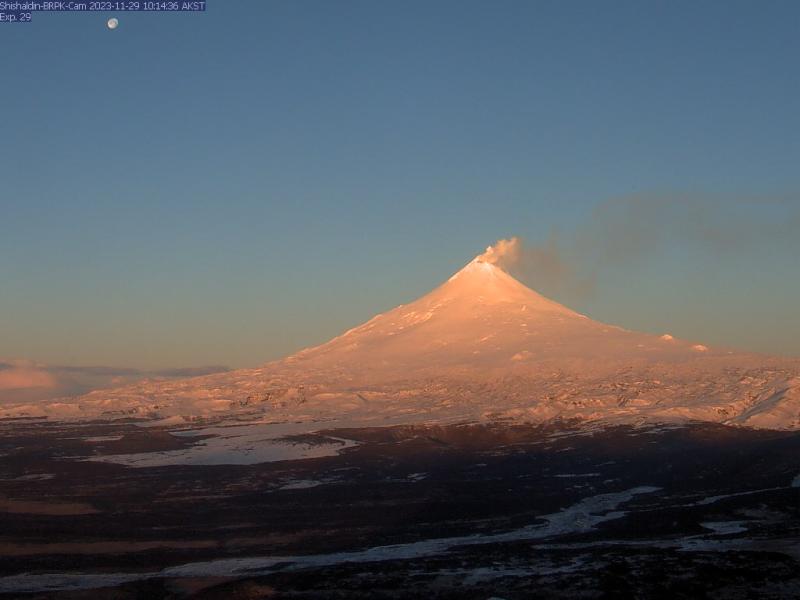
Strong northerly winds in the vicinity of Shishaldin Volcano have picked up loose volcanic ash and dust on the surface and are carrying it to the south-southwest. The National Weather Service has issued a SIGMET (https://www.weather.gov/aawu/sigmets) for this low-level event and suggests that the maximum cloud height is 9,000 ft (2.7 km) above sea level.
This phenomenon is not the result of recent volcanic activity and occurs during times of high winds and dry snow-free conditions at Shishaldin and other volcanic areas of Alaska. No eruption is in progress. All of the volcanoes of the Katmai area (Griggs, Katmai, Novarupta, Mageik, Martin, Snowy and Trident) remain at Aviation Color Code GREEN and Alert Level NORMAL. Resuspended volcanic ash should be considered hazardous and could be damaging to aircraft and health.
Instrumented