Pyre Peak 1977/3
Start: March 6, 1977 [1]
Stop: March 8, 1977 [1]
Event Type: Explosive
Max VEI: 1 [2]
- "Fire", "Glowing", or incandescence [3]
Description: From Miller and others (1998): "In early March, 1977 the crew of the U.S. Coast Guard Cutter Mellon reported eruptive activity. Eight lava fountains, up to 90 m high were noted along a radial rift about 1 km long and about 2.5 km southwest of the summit. At least two tongues of lava were extruded. The larger flow, 1 km wide, extended 1 km south. Neither tongue entered the sea. Pyroclastic material was also produced during the event. Dense clouds containing black ash and incandescent fragments were emitted from one or both of the vents effusing lava, and a coating of fine ash was visible on the surrounding snow. By March 8th, lava extrusion had apparently ceased, but a considerable amount of steam, possibly containing some ash, was still being discharged (Anchorage Times, March 8, 1977; Smithsonian Institution, 1977)." Although Miller and others (1998) cite the Anchorage Times, March 8th, as the source of the news article, the article appears in the March 7th edition.
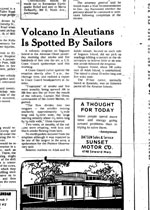
The March 7, 1977, Anchorage Times article states: "A volcanic eruption on Seguam Island in the Aleutian Chain yesterday morning shot smoke and fire hundreds of feet into the air, a U.S. Coast Guard spokesman said this mroning.
"A Coast Guard cutter spotted the eruption shortly after 7 a.m., Anchorage Time, and radioed a report to Coast Guard headquarters in Junear.
"'Fountains' of smoke and fire were steadily being spewed 100 to 200 feet into the air from the mouth of the voclano, Captain Hal Olson, commander of the cutter Mellon, reported.
"'The flow divides into two tongues - the smaller moving southerly approximately 1/2-mile long and 1/4 mile wide, the large moving steadily about 1 1/2 miles long by 1/2 mile wide,' Olson reported.
"Two vents, or mouths, of the volcano were erupting, with lava and black smoke flowing from both.
"No earthquakes occurred from the eruption although it was reported to be one of the largest in the area, a spokesman for the Palmer Observatory said.
"Seismic stations on Adak and Nikolski Islands, located on each side of Seguam Island, did not pick up readings leading scientists to believe little or no seismic action followed the eruption.
"Seguam Island, about 160 miles east of Adak Island, is uninhabited. The island is about 15 miles long and five miles wide.
"The 37-foot cutter, normally based in Honolulu, was on fisheries patrol off the Aleutian Islands."
Jicha and Singer (2006) measure the present volume of material erupted during the 1977 eruptions as 0.06 cubic km (6x10^7 cubic m).
The March 7, 1977, Anchorage Times article states: "A volcanic eruption on Seguam Island in the Aleutian Chain yesterday morning shot smoke and fire hundreds of feet into the air, a U.S. Coast Guard spokesman said this mroning.
"A Coast Guard cutter spotted the eruption shortly after 7 a.m., Anchorage Time, and radioed a report to Coast Guard headquarters in Junear.
"'Fountains' of smoke and fire were steadily being spewed 100 to 200 feet into the air from the mouth of the voclano, Captain Hal Olson, commander of the cutter Mellon, reported.
"'The flow divides into two tongues - the smaller moving southerly approximately 1/2-mile long and 1/4 mile wide, the large moving steadily about 1 1/2 miles long by 1/2 mile wide,' Olson reported.
"Two vents, or mouths, of the volcano were erupting, with lava and black smoke flowing from both.
"No earthquakes occurred from the eruption although it was reported to be one of the largest in the area, a spokesman for the Palmer Observatory said.
"Seismic stations on Adak and Nikolski Islands, located on each side of Seguam Island, did not pick up readings leading scientists to believe little or no seismic action followed the eruption.
"Seguam Island, about 160 miles east of Adak Island, is uninhabited. The island is about 15 miles long and five miles wide.
"The 37-foot cutter, normally based in Honolulu, was on fisheries patrol off the Aleutian Islands."
Jicha and Singer (2006) measure the present volume of material erupted during the 1977 eruptions as 0.06 cubic km (6x10^7 cubic m).
Images
References Cited
[1] Seguam, 1977
Smithsonian Institution, 1977, Seguam: Scientific Event Alert Network Bulletin v. 02, n. 03, unpaged.[2] Volcanoes of the world [2nd edition], 1994
Simkin, Tom, and Siebert, Lee, 1994, Volcanoes of the world [2nd edition]: Tucson, Arizona, Geoscience Press, 349 p.[3] Volcano in Aleutians is spotted by sailors, 1977
Unknown, 1977, Volcano in Aleutians is spotted by sailors: Anchorage Times, March 7, 1977, pages unknown.[4] Catalog of the historically active volcanoes of Alaska, 1998
Miller, T. P., McGimsey, R. G., Richter, D. H., Riehle, J. R., Nye, C. J., Yount, M. E., and Dumoulin, J. A., 1998, Catalog of the historically active volcanoes of Alaska: U.S. Geological Survey Open-File Report 98-0582, 104 p. intro and TOC PDF 268 KB
references PDF 43 KB
intro and TOC PDF 268 KB
references PDF 43 KB Complete Eruption References
3D diffusion of water in melt inclusion-bearing olivine phenocrysts, 2024
Mutch, E.J.F., Newcombe, M.E., and Rudge, J.F., 2024, 3D diffusion of water in melt inclusion-bearing olivine phenocrysts: Geochemistry, Geophysics, Geosystems v. 25, no. 3, e2023GC011365. https://doi.org/10.1029/2023GC011365
Full-text PDF 3.5 MB
Supplementary information 5.7 MB  Supplementary data (zip) 21 MB
 Water-in-olivine magma ascent chronometry - Every crystal is a clock, 2020
Newcombe, M.E., Plank, T., Barth, A., Asimow, P.A., and Hauri, E., 2020, Water-in-olivine magma ascent chronometry - Every crystal is a clock: Journal of Volcanology and Geothermal Research v. 398, 106872. https://doi.org/10.1016/j.jvolgeores.2020.106872
An assessment of clinopyroxene as a recorder of magmatic water and magma ascent rate, 2016
Lloyd, A.S., Ferriss, E., Ruprecht, P., Hauri, E.H., Jicha, B.R., and Plank, T., 2016, An assessment of clinopyroxene as a recorder of magmatic water and magma ascent rate: Journal of Petrology, v. 57, n. 10, p. 1865-1886.
Bubbles matter - An assessment of the contribution of vapor bubbles to melt inclusion volatile budgets, 2015
Moore, L.R., Gazel, E., Tuohy, R., Lloyd, A.S., Esposito, R., Steele-MacInnis, M., Hauri, E.K., Wallace, P.J., Plank, T., and Bodnar, R.J., 2015, Bubbles matter - An assessment of the contribution of vapor bubbles to melt inclusion volatile budgets: American Mineralogist v. 100, no. 4, p. 806-823. https://doi.org/10.2138/am-2015-5036
The role of water in generating the calc-alkaline trend: new volatile data for Aleutian magmas and a new tholeiitic index, 2010
Zimmer, M.M., Plank, Terry, Hauri, E.H., Yogodzinski, G.M., Stelling, Peter, Larsen, Jessica, Singer, Brad, Jicha, Brian, Mandeville, Charles, and Nye, C.J., 2010, The role of water in generating the calc-alkaline trend: new volatile data for Aleutian magmas and a new tholeiitic index: Journal of Petrology, v. 5, n. 12, p. 2411, 2444, doi:10.1093/petrology/egq062 .
Volcanic history and magmatic evolution of Seguam Island, Aleutian island arc, Alaska, 2006
Jicha, B.R., and Singer, B.S., 2006, Volcanic history and magmatic evolution of Seguam Island, Aleutian island arc, Alaska: Geological Society of America Bulletin, v. 118, n. 7-8, p. 805-822.
Catalog of the historically active volcanoes of Alaska, 1998
Miller, T. P., McGimsey, R. G., Richter, D. H., Riehle, J. R., Nye, C. J., Yount, M. E., and Dumoulin, J. A., 1998, Catalog of the historically active volcanoes of Alaska: U.S. Geological Survey Open-File Report 98-0582, 104 p.
intro and TOC PDF 268 KB
references PDF 43 KB 
Volcanoes of the world [2nd edition], 1994
Simkin, Tom, and Siebert, Lee, 1994, Volcanoes of the world [2nd edition]: Tucson, Arizona, Geoscience Press, 349 p.
Seguam, 1977
Smithsonian Institution, 1977, Seguam: Scientific Event Alert Network Bulletin v. 02, n. 03, unpaged.
Volcano in Aleutians is spotted by sailors, 1977
Unknown, 1977, Volcano in Aleutians is spotted by sailors: Anchorage Times, March 7, 1977, pages unknown.