Amukta 1963/2
Start: February 13, 1963 [1]
Stop: February 28, 1963 [1]
Event Type: Explosive
Max VEI: 3 [2]
- Radial fissure [1]
- Flank eruption [1]
Description: From Miller and others (1998): "On February 13, 1963 an eruption occurred involving the central crater and one or more parasitic vents; both ash and lava were produced (Anchorage Times, February 11, 1963; Decker, 1967). Persistent low clouds obscured the exact source of the lava, but the flow was seen to extend from the west side of the cone southwest into the sea at Traders Cove (Bulletin of Volcanic Eruptions, 1963 [Coats, R.R., 1963]."
The text of the Anchorage Times, February 11, 1963 article is as follows: "KODIAK - A volcano is erupting near Amukta Island on the Aleutian Chain, according to reports received at the Kodiak Naval Station.
"A Navy plane yesterday flew near the scene and crewmen reported a mountain billowing dark gray and black smoke about 500 feet in the air. Lava is flowing from the cone to the ocean 3,700 feet below. Mushroom-shaped steam clouds are rising where the lava enters the ocean.
"The volcano is erupting about every 15 mintues and was continuing its activity today, say latest reports.
"The volcanic cloud was first spotted from the Navy ship Mizar."
From volcano observations on file at UAF/GI: "Facts reported by pilot of U.S. Navy aircraft that observed and photographed Amukta island volcano on 19 February 1963:
'We arrived over Amukta Island at an altitude of 500 feet. The approach was made from the north end of the island. Huge billowing clouds of steam were rising from the volcano to an altitude of 800 feet. No lava was present on the north and east side of the island. We continued down the west side of the island and saw a stream of red flowing lava, approximately 20-30 wide [units not given], from the obscured area of the volcano at an approximate altitude of 2,000 feet, to the southwest area of the island, where it ended.
'Hot lava was present in the sea on the southwest corner of the island where many small columns of steam were rising. Numerous passes were made to the northwest and the southeast across the plateau on the southwest corner of the island. Photographs were taken. These pictures included those taken from a minimum of altitude of 200 feet to 9,000 feet. The high altitude shots were made from east due to sun location; partial cloud cover did not permit photography of all aspects of the island.
'Lava flow was to the west only in one large stream to the west from the crater, turning and flowing toward the water line on the southwest corner. The other three sides of the island appeared unaffected with only a light covering of dust visible. The billowing columns of steam and smoke coming from the crater were very white, turning grey to darker shades at intervals. Seals in large numbers still inhabited the entire west shoreline of the island.'"
The text of the Anchorage Times, February 11, 1963 article is as follows: "KODIAK - A volcano is erupting near Amukta Island on the Aleutian Chain, according to reports received at the Kodiak Naval Station.
"A Navy plane yesterday flew near the scene and crewmen reported a mountain billowing dark gray and black smoke about 500 feet in the air. Lava is flowing from the cone to the ocean 3,700 feet below. Mushroom-shaped steam clouds are rising where the lava enters the ocean.
"The volcano is erupting about every 15 mintues and was continuing its activity today, say latest reports.
"The volcanic cloud was first spotted from the Navy ship Mizar."
From volcano observations on file at UAF/GI: "Facts reported by pilot of U.S. Navy aircraft that observed and photographed Amukta island volcano on 19 February 1963:
'We arrived over Amukta Island at an altitude of 500 feet. The approach was made from the north end of the island. Huge billowing clouds of steam were rising from the volcano to an altitude of 800 feet. No lava was present on the north and east side of the island. We continued down the west side of the island and saw a stream of red flowing lava, approximately 20-30 wide [units not given], from the obscured area of the volcano at an approximate altitude of 2,000 feet, to the southwest area of the island, where it ended.
'Hot lava was present in the sea on the southwest corner of the island where many small columns of steam were rising. Numerous passes were made to the northwest and the southeast across the plateau on the southwest corner of the island. Photographs were taken. These pictures included those taken from a minimum of altitude of 200 feet to 9,000 feet. The high altitude shots were made from east due to sun location; partial cloud cover did not permit photography of all aspects of the island.
'Lava flow was to the west only in one large stream to the west from the crater, turning and flowing toward the water line on the southwest corner. The other three sides of the island appeared unaffected with only a light covering of dust visible. The billowing columns of steam and smoke coming from the crater were very white, turning grey to darker shades at intervals. Seals in large numbers still inhabited the entire west shoreline of the island.'"
References Cited
[1] Aleutian Islands and Alaska, 1963
Coats, R. R., 1963, Aleutian Islands and Alaska: Bulletin of Volcanic Eruptions, v. 3, p. 3.[2] Volcanoes of the world [2nd edition], 1994
Simkin, Tom, and Siebert, Lee, 1994, Volcanoes of the world [2nd edition]: Tucson, Arizona, Geoscience Press, 349 p.[3] Volcano Erupting, 1963
Unknown, 1963, Volcano Erupting: Anchorage Daily Times, n. Feb 11, p. 2.[4] Volcano observations, 1954
Unknown, 1954, Volcano observations: Unpublished volcano observation sheets filled out by U.S. military and stored on file at the Geophyiscal Institute, University of Alaska Fairbanks, unpaged.[5] Investigations at active volcanoes, 1967
Decker, R. W., 1967, Investigations at active volcanoes: Adams, L. H. and Schairer, J. F., (eds.), Eos, v. 48, n. 2, p. 639-647.Complete Eruption References
Catalog of the historically active volcanoes of Alaska, 1998
Miller, T. P., McGimsey, R. G., Richter, D. H., Riehle, J. R., Nye, C. J., Yount, M. E., and Dumoulin, J. A., 1998, Catalog of the historically active volcanoes of Alaska: U.S. Geological Survey Open-File Report 98-0582, 104 p.
 intro and TOC PDF 268 KB
references PDF 43 KB
intro and TOC PDF 268 KB
references PDF 43 KB 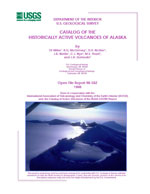
Volcanoes of the world [2nd edition], 1994
Simkin, Tom, and Siebert, Lee, 1994, Volcanoes of the world [2nd edition]: Tucson, Arizona, Geoscience Press, 349 p.
Hard Copy held by AVO at FBKS - CEC shelf
Investigations at active volcanoes, 1967
Decker, R. W., 1967, Investigations at active volcanoes: Adams, L. H. and Schairer, J. F., (eds.), Eos, v. 48, n. 2, p. 639-647.
Hard Copy held by AVO at FBKS - CEC file cabinet
Aleutian Islands and Alaska, 1963
Coats, R. R., 1963, Aleutian Islands and Alaska: Bulletin of Volcanic Eruptions, v. 3, p. 3.
Hard Copy held by AVO at FBKS - CEC file cabinet
Volcano Erupting, 1963
Unknown, 1963, Volcano Erupting: Anchorage Daily Times, n. Feb 11, p. 2.
Hard Copy held by AVO at FBKS - CEC file cabinet
Volcano observations, 1954
Unknown, 1954, Volcano observations: Unpublished volcano observation sheets filled out by U.S. military and stored on file at the Geophyiscal Institute, University of Alaska Fairbanks, unpaged.
Hard Copy held by AVO at FBKS - CEC file cabinet